


Consistency, Job After Job
Most homeowners hire a roofing contractor once every 15 to 20 years. You're not expected to know what good work looks like; that's on us to show you, not something you should have to take on faith.
Turtle Roofing has completed more than 3,345 projects across 14 years in the Midwest. A few things stay consistent no matter the job:
- We show up when we say we will. No rescheduling without a call, no radio silence between the estimate and the start date.
- The person you talk to at the start is the person you talk to at the end. No handoffs to someone who wasn't there for the original conversation.
- We tell you the real cost before we start, and stick to it. If something changes once we're into the project, you hear about it before it happens, not after.
- We check back after major storms. Through the Shell Protection Program, we reach out proactively instead of waiting for you to notice a problem months later.
We take the same approach on every job, whether it's the first project or the fiftieth. That’s why homeowners across the Midwest call us back for the next project, and refer us to their neighbors after the first one.
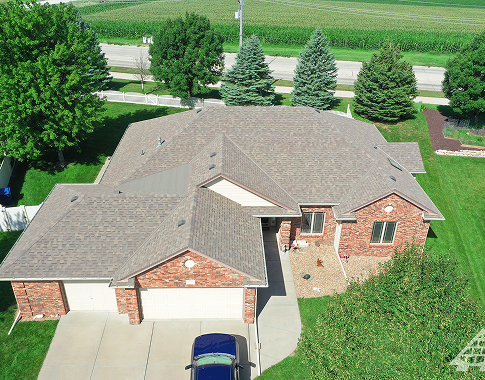
The Storm Damage You Don't See Coming
A storm gives you obvious problems like missing shingles, dented gutters, or a tree limb through the roof deck. Water intrusion is more subtle. It can come from a single failed flashing point and travel along a rafter for several feet before it ever reaches your ceiling.
This makes water intrusion damage tricky to diagnose without experience. The stain on your bedroom ceiling might trace back to a roof valley on the opposite side of the house. Chasing the visible symptom instead of the source is the single most common reason water intrusion damage repairs fail and the same spot leaks again a year later.
Before Turtle Roofing repairs anything, we trace the damage back to where the water actually got in, so the fix holds through the next storm instead of showing up again next spring.

Signs You May Have Water Intrusion
Water intrusion can be difficult to detect. A few homeowners catch it from a stain that shows up overnight. Most notice something smaller first, like a smell that wasn't there before or a wall that feels different to the touch, and don't connect it to water until the damage has already spread.
Here's what to look for, whether it's new or something you've been noticing for a while:
- Yellow or brown ceiling stains, especially ones that grow after rain
- A musty smell in the attic, closet, or upper floor
- Soft or spongy drywall near windows, skylights, or exterior walls
- Peeling paint or bubbling wallpaper on an exterior-facing wall
- Visible mold or mildew in the attic insulation
- Higher-than-usual humidity in upper rooms during wet weather
If you're noticing more than one of these at once, the damage has likely been developing for a while.

Common Sources of Water Intrusion
Water intrusion typically traces back to one of a handful of entry points. Each one behaves differently, and each needs a different repair approach.
Roof Flashing Failures

Flashing seals the seams around chimneys, skylights, and roof-to-wall transitions. When it corrodes, separates, or was installed with the wrong overlap, water works its way underneath during every rain event, not just heavy storms.
Ice Dam Backup
Midwest winters create ice dams when heat escapes through the attic, melts snow on the roof, and refreezes at the colder eaves. The resulting ice ridge forces meltwater backward under the shingles, where it has nowhere to go but into your insulation and ceiling drywall.
Gutter and Downspout Failure
Gutters that are clogged, pitched incorrectly, or pulling away from the fascia send water straight down the side of the house instead of away from it. Over time, that water finds gaps in siding, window trim, and foundation seals.
Aging or Cracked Pipe Boots
The rubber boot around a plumbing vent pipe is one of the first roofing components to fail. A cracked boot is a small, cheap fix if caught early, and a rotted deck if it isn't.


Find the Leak, Fix the Source & Repair the Damage
Turtle Roofing keeps the water intrusion damage repair process simple on your end. One thorough look at your home covers everything relevant to the problem, so you're not left piecing together what's going on from separate visits and separate opinions. From there, we walk you through exactly what we found and what it will take to fix it, in plain language, start to finish.
1. Home Inspection
Step one is a full inspection, inside and out. We check the roof surface, flashing, gutters, attic insulation, and interior ceiling or wall damage together, because they're rarely separate problems. A ceiling stain in the guest room and a soft spot in the attic decking three feet away are almost always connected.
2. Documentation & Recommendations
From there, we document what we find with photos and a written scope, so you understand what's happening before any work begins. If the damage is storm-related, we'll walk you through what your insurance policy is likely to cover and help you prepare for the adjuster visit.
3. Water Damage Intrusion Repair
Repair work depends on what we find, but generally includes:
- Source Correction: Replacing failed flashing, cracked pipe boots, or damaged shingles so water stops entering.
- Deck and Structural Repair: Replacing any rotted or weakened roof decking before new materials go down.
- Interior Restoration: Coordinating drywall, insulation, and paint repair so the visible damage gets addressed, not just covered up.
- Ventilation Review: Checking attic airflow, since poor ventilation is a leading cause of ice dam formation in Midwest winters